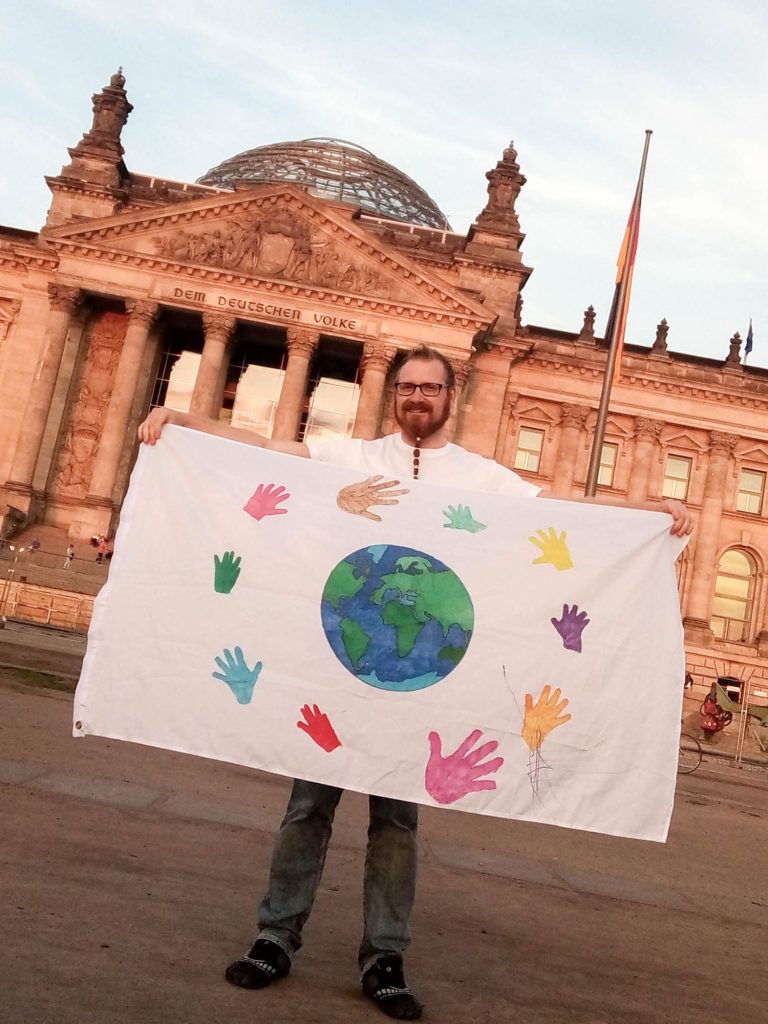
A Draft Planetary Constitution for Planet Earth
Compatible with the United Nations and the ‘One World Parliament Design’ model
Preamble
We, the peoples of the Earth,
mindful of our shared responsibility for humanity, peace, freedom, dignity and the planet’s natural resources,
recognising the cultural, linguistic, religious and political diversity of humanity,
building upon the aims and principles of the United Nations,
determined to permanently overcome wars between nations, promote global justice and democratically legitimise planetary cooperation,
adopt this Planetary Constitution of Earth.
PART I – BASIC STRUCTURE OF THE PLANETARY COMMUNITY
Article 1 – The Planetary Community
1. The Earth constitutes a democratic planetary community of free states and free people.
2. The sovereignty of the Member States shall be preserved insofar as this Constitution does not expressly establish planetary competences.
3. This Constitution supplements the Charter of the United Nations and further develops it institutionally.
4. Human dignity is inviolable. Respecting and protecting it is the duty of all planetary bodies.
Article 2 – Objectives of the Planetary Order
The Planetary Community pursues the following objectives in particular:
1. Safeguarding world peace;
2. Protecting human rights;
3. Protection of the climate and the biosphere;
4. Promotion of global social justice;
5. Democratic participation of all people;
6. Protection of future generations;
7. Peaceful resolution of international conflicts;
8. Scientific, cultural and technological cooperation.
Article 3 – Relationship with the Charter of the United Nations
1. The Charter of the United Nations remains the foundation of international peace law.
2. Global institutions shall operate within the institutional framework of the United Nations or its successor organisation.
3. The bodies of this Constitution may be established gradually through treaties under international law.
4. No provision of this Constitution shall be interpreted as justifying the use of aggressive force.
PART II – FUNDAMENTAL RIGHTS
Article 4 – Fundamental Planetary Rights
Every person possesses, in particular:
1. the right to life and safety;
2. freedom of expression, freedom of the press and freedom of information;
3. freedom of religion and belief;
4. democratic participation;
5. protection against discrimination;
6. access to education;
7. access to water, food and basic healthcare;
8. Protection of personal data;
9. The right to a liveable environment.
Article 5 – Rights of future generations
1. The Earth’s natural resources are subject to planetary protection.
2. Government and planetary action must be fair to future generations.
3. The World Youth Parliament is granted special rights of participation to protect future generations.
PART III – THE PLANETARY ORGANS
Article 6 – Organs of the Planetary Community
The bodies of the Planetary Community are:
1. the World Parliament;
2. the World Youth Parliament;
3. the Planetary Leadership;
4. the Grand Planetary Court;
5. the United Nations and its recognised specialised agencies.
PART IV – THE WORLD PARLIAMENT
Article 7 – Role of the World Parliament
1. The World Parliament is the democratic legislative body representing humanity.
2. It acts in a complementary capacity to the United Nations General Assembly.
3. Seats are allocated in accordance with the provisions of this Constitution and the population figures of the Member States.
Article 8 – Seat models
The seating arrangements in the World Parliament are based on the official models of the ‘One World Parliament Design’ system:
• Full capacity: 4,680 seats
• ¾ capacity: 3,510 seats
• ½ capacity: 2,340 seats
• ¼ capacity: 1,170 seats
• Continental representation: 144 seats
Article 9 – Electoral Principles
1. Members of the World Parliament shall be elected by universal, free, equal and secret ballot.
2. Member States shall organise the election in accordance with common planetary minimum standards.
3. Minorities and smaller states shall be given due consideration.
Article 10 – Responsibilities
In particular, the World Parliament resolves:
1. planetary framework laws;
2. the planetary budget;
3. climate and environmental standards;
4. global human rights standards;
5. recommendations to the United Nations;
6. measures to monitor the Planetary Leadership.
PART V – THE WORLD YOUTH PARLIAMENT
Article 11 – Role of the World Youth Parliament
1. The World Youth Parliament represents the younger generations of the world.
2. It has the right to participate in, be consulted on, and exercise a suspensive veto over matters concerning the future.
3. Its approval is required for fundamental legislation on climate, education and intergenerational issues.
Article 12 – Seating arrangements for the World Youth Parliament
The seating arrangements are based on the official models:
• Minimum: 780 seats
• Medium: 1,560 seats
• Maximum: 3,120 seats
• Continental: 96 seats
Article 13 – Rights of the World Youth Parliament
The World Youth Parliament can:
1. Introduce legislative proposals;
2. Request reports on the future;
3. Hold global youth consultations;
4. Refer laws back for further consideration.
PART VI – PLANETARY LEADERSHIP
Article 14 – Status
1. The Planetary Executive is the executive branch of the Planetary Community.
2. It represents humanity within the framework of this Constitution.
3. It acts in accordance with the laws of the World Parliament.
Article 15 – Election
1. The Planetary Leadership is elected democratically.
2. The electoral process is governed by planetary law.
3. Regional balance within humanity must be taken into account.
Article 16 – Powers
The Planetary Leadership:
1. enforces planetary laws;
2. represents the Planetary Community internationally;
3. swears in the planetary bodies;
4. may introduce legislative proposals;
5. coordinates crisis response measures;
6. publishes planetary development reports.
Article 17 – The PL vote and the split vote
1. The Planetary Executive may, by means of a PL vote, prioritise bills from the chambers for consideration by the Plenary Assembly.
2. The split vote allows for dual approval by the World Parliament, the relevant chambers and the World Youth Parliament on fundamental planetary issues.
3. The details shall be laid down by law.
PART VII – THE GREAT PLANETARY COURT
Article 18 – Status
1. The Grand Planetary Court is the supreme court of the Planetary Community.
2. It ensures compliance with this Constitution.
3. Its judicial independence is inviolable.
Article 19 – Responsibilities
In particular, the court shall rule on:
1. Constitutional disputes;
2. Conflicts between planetary bodies;
3. Complaints regarding violations of fundamental planetary rights;
4. Disputes between Member States;
5. The compatibility of planetary laws with this Constitution.
Article 20 – Composition
1. Judges are elected for a fixed term.
2. The world’s regions should be fairly represented.
3. Re-election may be ruled out in order to ensure independence.
PART VIII – LEGISLATION
Article 21 – Legislative procedure
1. Bills may be introduced by:
o the World Parliament,
o the World Youth Parliament,
o the Planetary Leadership,
o a planetary citizens’ initiative.
2. Bills generally require:
o a majority vote in the World Parliament,
o as well as the involvement of the World Youth Parliament.
Article 22 – Global Citizens’ Initiative
1. Citizens of Earth may submit legislative proposals.
2. The details are set out in a planetary participation law.
PART IX – PEACE AND SECURITY
Article 23 – Prohibition of violence
1. Wars of aggression are prohibited.
2. The use of military force is permitted only in self-defence or in accordance with international law.
3. The aim of the Planetary Community is long-term global disarmament.
Article 24 – Council of Generals
1. An advisory council of generals may be established for the purpose of strategic security coordination.
2. The council is subject to democratic oversight by the planetary bodies.
3. It has no independent legislative power.
PART X – FINANCE AND ADMINISTRATION
Article 25 – Planetary Budget
1. The Planetary Community has its own budget.
2. The budget is approved by the World Parliament.
3. Transparency and public scrutiny must be ensured.
PART XI – AMENDMENT OF THE CONSTITUTION
Article 26 – Amendments to the Constitution
1. Amendments to this Constitution require:
o a two-thirds majority of the World Parliament,
o a majority of the World Youth Parliament,
o and ratification by the Member States.
2. Human dignity, the democratic order and fundamental rights are unalterable.
PART XII – FINAL PROVISIONS
Article 27 – Transitional provisions
1. This Constitution may be introduced in stages.
2. The first planetary bodies may initially perform advisory functions.
3. As ratification progresses, binding powers may be transferred.
Article 28 – Entry into force
This Constitution shall enter into force following ratification by a number of states as specified under international law.
Constitutional classification
The draft has been deliberately formulated as a hybrid system compatible with the UN, rather than as a fully-fledged world government. This is far more realistic from a political perspective and more compatible with existing international law.
The design is structurally similar:
• federal constitutions,
• the development of the European Union,
• parliamentary democracies,
• and an expanded UN system.
As a result, the model appears to be far more institutionally compatible than traditional utopian visions of a world state.
For a democratic world parliament
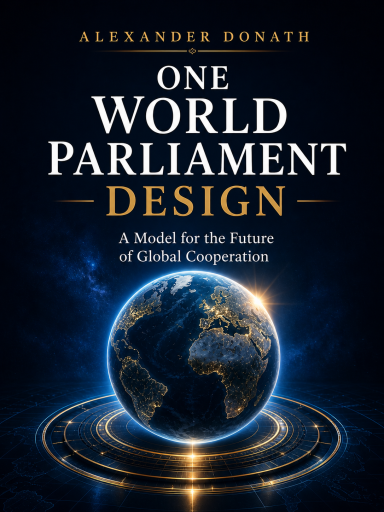
Book: One World Parliament Design by Alexander Donath
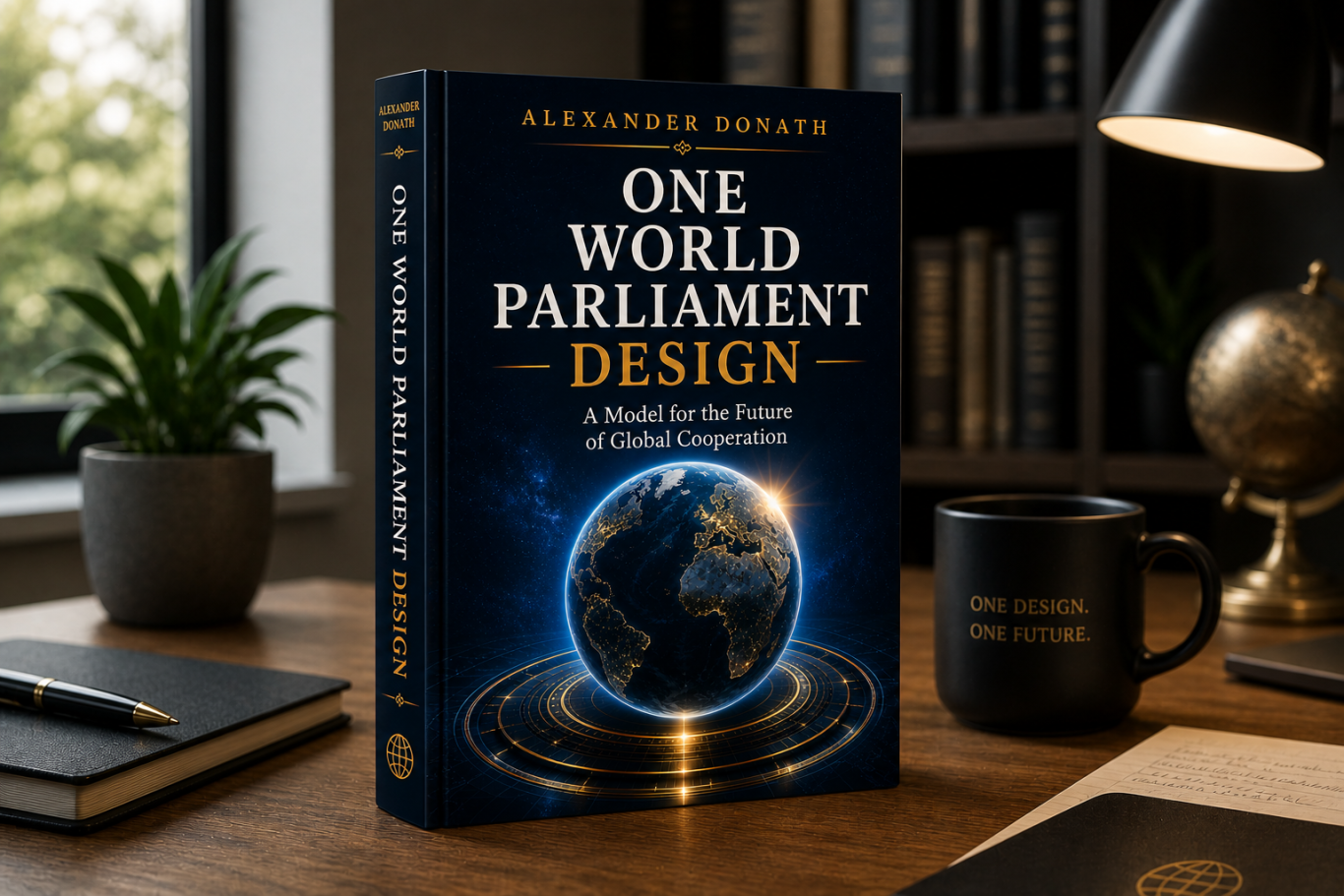
What might a functioning global order look like?
“One World Parliament Design” develops a comprehensive model for a new form of international cooperation. In a world where global challenges increasingly transcend national borders, this book poses the central question: Are existing systems still sufficient – or is a new level of coordination required?
This work combines analysis, system design and future perspectives into a structured overall concept. At its heart is a World Parliament as a complementary, democratically legitimised body that steps in where today’s structures reach their limits.
Now available on Amazon and as a download pdf.